

TL;DR
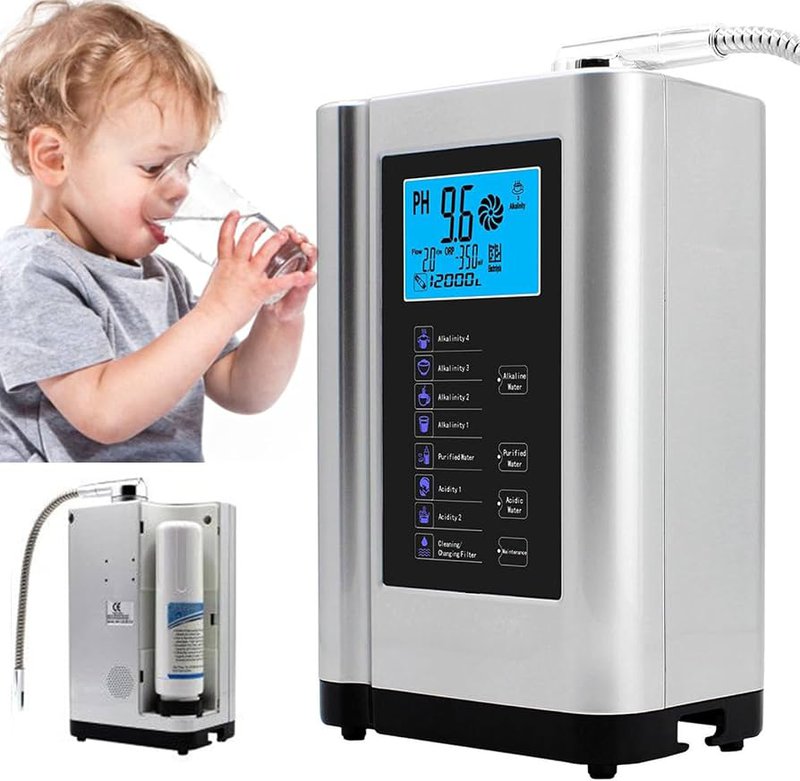
Older electric water ionisers were designed primarily to separate tap water into alkaline and acidic streams. Molecular hydrogen was always created at the negative electrode, but for decades it was treated as an unimportant gas or simply one of several properties of alkaline ionised water.
The Higen represents a different design philosophy. It still uses electrochemistry, but its headline purpose is to produce measurable molecular-hydrogen water—not to win a contest for the highest pH. Using PEM technology, a Nafion™ membrane and high-purity platinum electrodes, the Higen produces hydrogen drinking water while keeping ozone water separate. Hydrogen has moved from overlooked co-product to the main event.
Were electric water ionisers originally
hydrogen-water machines?
The short answer is no—not in the way we understand a hydrogen-water machine today.
Traditional electric water ionisers were developed to use electrolysis to divide ordinary water into two streams:
- alkaline water from the negative electrode, or cathode; and
- acidic water from the positive electrode, or anode.
Their performance was usually promoted through pH levels, negative oxidation-reduction potential (ORP), plate count and the ability to create several types of alkaline and acidic water.
Hydrogen was present, but it was rarely the number on the front of the brochure.
That is very different from the Higen hydrogen-water range, where the concentration of molecular hydrogen is stated in parts per billion and the user can select different hydrogen levels.
The machines belong to the same broad electrochemical family, but they were developed around different outcomes.
Why did the old ionisers produce hydrogen at all?
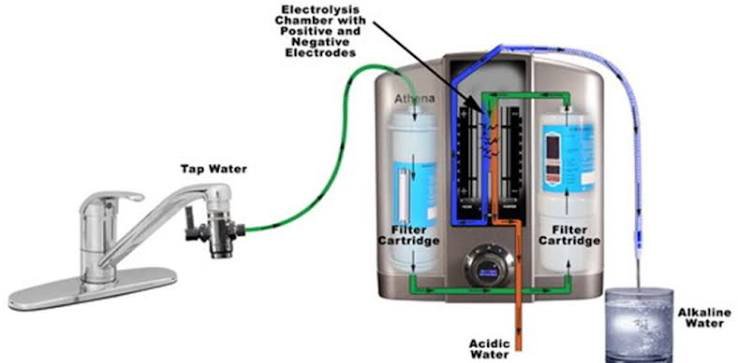
At the negative electrode of an electric ioniser, water undergoes a reduction reaction:
2H₂O + 2e⁻ → H₂ + 2OH⁻
This reaction produces:
- hydroxide ions, which help raise the pH; and
- molecular hydrogen gas, some of which dissolves in the water.
Hydrogen was therefore not a mysterious accident. It was an unavoidable part of the electrochemistry.
However, the original commercial objective was the alkaline water. The hydrogen was more accurately an overlooked co-product. The gas was known to be present, but its possible biological relevance was not yet the focus.
How history shaped the older ioniser
Research into alkaline ionised water in Japan is commonly dated to the 1930s. In 1965, Japan recognised domestic electrolytic-water apparatus for certain gastrointestinal uses. The machines were described and regulated around alkaline drinking water and acidic external-use water—not around a measured dose of dissolved H₂.
That history shaped the products that followed.
For decades, the industry concentrated on making the drinking stream increasingly alkaline. Machines added more settings, larger electrolysis chambers and more electrode plates. Sales presentations often placed great importance on extreme pH and very negative ORP readings.
Molecular hydrogen was sitting quietly in the glass, but almost nobody was asking how much was actually there.
The scientific story began to change
In 1997, Shirahata and colleagues published laboratory research on electrolysed reduced water and oxidative damage. The paper referred to “active hydrogen” and reported high dissolved molecular hydrogen. It was an in-vitro study rather than a human clinical trial, but it was an important step away from the idea that pH alone explained everything.
The next major turning point came in 2007, when Ohsawa and colleagues published research in Nature Medicine examining molecular hydrogen in cell and animal models. The study was not a trial of household ionised water, and it did not prove that hydrogen water could treat disease. What it did do was make H₂ a serious subject for biological research.
After that, researchers increasingly measured hydrogen concentration rather than relying only on pH or ORP. The question changed from:
“How alkaline is the water?”
to:
“How much molecular hydrogen is actually dissolved in it?”
That change eventually led to products designed around hydrogen itself.
Where Higen changes the story
The Higen is not simply an old alkaline ioniser with a new hydrogen sticker on the front.
Its design purpose is different. The Higen 1+ countertop system and Higen 2+ under-sink system are promoted according to their hydrogen concentration, filtration and delivery—not according to how high they can push the drinking water’s pH.
The Higen uses patented KYK proton-exchange-membrane technology, commonly shortened to PEM. Its Nafion™ membrane and platinum electrodes are designed to generate hydrogen drinking water while isolating the ozone-water output.
That separation matters. Hydrogen water is made for drinking. Ozone water is delivered separately for washing produce and cleaning surfaces. The drinking water is not meant to contain ozone.
The result is an electrical water system in which molecular hydrogen is a planned and measured output rather than a poorly reported side-effect.
Older ioniser and Higen compared
| Main design objective | Produce alkaline and acidic water | Produce selectable molecular-hydrogen water, purified water and separate ozone water |
| Traditional headline measurements | pH, ORP and number of electrode plates | Dissolved-hydrogen concentration in ppb, hydrogen levels and flow rate |
| Electrolysis approach | Conventional plate chamber separated by a diaphragm or membrane | KYK PEM technology using a Nafion™ membrane and high-purity platinum electrodes |
| Hydrogen’s original role | Inevitable but often unmeasured co-product of the alkaline stream | Deliberate, specified drinking-water output |
| Drinking-water choices | Several alkaline pH levels, often with an acidic second stream | Selectable hydrogen levels plus purified water |
| Secondary water | Acidic or oxidising water, frequently sent to waste if not collected | Separate ozone water intended for cleaning and washing |
| Relationship to pH | High drinking-water pH is a central objective | Hydrogen concentration is the central objective; the system is not marketed as a contest for extreme pH |
| Filtration | Varies considerably by brand and model | Integrated filtration; dual 13-layer filtration in the Higen 2+ |
| Cleaning | Plate scaling can require regular cleaning and maintenance | Automatic pole-exchange cleaning after use, plus scheduled filter replacement |
| Installation | Usually countertop, with separate alkaline and acidic outlets | Higen 1+ countertop or Higen 2+ under-sink with dedicated tap |
The Higen models at a glance
| Specification | Higen 1+ | Higen 2+ |
|---|---|---|
| Installation | Countertop | Under-sink |
| Hydrogen settings | Three: high, medium and low | Two hydrogen levels, plus purified water |
| Maximum stated hydrogen | Up to 1,200 ppb | Up to 1,575 ppb |
| Stated average ORP | –410 mV | –620 mV |
| Flow rate | 0.6 litres per minute | 1.2 litres per minute |
| Filtration | Single premium filter | Dual 13-layer filtration |
| Nominal filter life | 3,000 litres or about 12 months | 3,000 litres or about 12 months |
| Other output | Purified water and ozone water | Purified water and ozone water |
In water, 1,000 ppb is equivalent to 1.0 milligram per litre. That means the Higen’s hydrogen claim is a concentration that can be tested—not simply inferred from a pH or ORP reading.
As with every hydrogen-water appliance, actual results can vary with operating conditions, flow, water temperature, maintenance and the way the water is collected. Hydrogen is a tiny gas molecule and begins escaping once the water is exposed to air. It is best consumed reasonably soon after dispensing.
Why PEM technology is significant
PEM systems were developed to manage the movement of protons across a specialised membrane. In a hydrogen-water generator, this gives the designer more control over gas separation and hydrogen delivery than a conventional alkaline-ioniser layout designed primarily to shift pH.
The Higen’s technology does three particularly useful things:
- it makes molecular hydrogen an intentional output;
- it isolates ozone water from the hydrogen drinking water; and
- it lets the user select hydrogen water without needing to choose an extreme alkaline pH.
This does not mean that a traditional ioniser cannot produce worthwhile dissolved hydrogen. Many can. The problem is that two ionisers displaying a similar pH or ORP may not deliver the same H₂ concentration.
Hydrogen output in a conventional ioniser can vary with electrode condition, electrical current, flow rate, water temperature and the mineral content or conductivity of the incoming water. Scale on the plates can also reduce performance over time.
If molecular hydrogen is the goal, it makes sense to begin with technology designed and measured for that goal.
pH, ORP and H₂ are not the same measurement
Three ideas are often mixed together in water marketing:
pH
pH describes hydrogen-ion activity and tells us whether water is acidic, neutral or alkaline. It does not measure dissolved molecular hydrogen gas.
ORP
ORP indicates how strongly a water sample tends to participate in oxidation or reduction reactions. Dissolved hydrogen can contribute to a negative ORP, but ORP is also strongly affected by pH, temperature and other substances. It is not a direct H₂ test.
Dissolved molecular hydrogen
This is the concentration of H₂ gas actually dissolved in the water, usually expressed as ppb, ppm or milligrams per litre. It is the measurement most relevant when comparing hydrogen-water systems.
An old-style ioniser may display an impressive alkaline pH and a very negative ORP while providing surprisingly little retained H₂ by the time the water reaches the glass. Conversely, a purpose-built hydrogen system can provide measurable H₂ without making extreme alkalinity its main selling point.
Filtration still comes first
Generating molecular hydrogen does not remove the need for proper water filtration.
The Higen combines hydrogen generation with filtration because the starting water still matters. The Higen 2+ uses two filters with 13 filtration layers, while the Higen 1+ uses a multi-layer filter incorporating sediment filtration, calcium-sulfite ceramic, antimicrobial filtration and activated carbon.
This is an important difference between a complete water system and a simple hydrogen-producing gadget. The objective should not be to add hydrogen to poor-quality water. It should be to begin with properly filtered water and then generate hydrogen in a controlled way.
The Higen is intended for treated municipal water. Untreated bore, tank or river water may require testing and additional treatment. The Higen 1+ product information also notes that it does not remove fluoride without an added fluoride pre-filter.
Does this make every older ioniser obsolete?
No. It depends on what the owner wants.
Someone who specifically wants a range of alkaline and acidic pH settings may still prefer a conventional ioniser. Acidic water can be collected for certain household uses, and some people enjoy the taste of moderately alkaline water.
But if the real reason for buying an electrical water machine is molecular hydrogen, a purpose-built system such as Higen is the more direct comparison.
The buying decision should then concentrate on:
- tested dissolved-H₂ output under realistic conditions;
- filtration quality and contaminant test results;
- hydrogen output at the normal drinking-water flow rate;
- ease of cleaning and filter replacement;
- Australian service and replacement-filter availability;
- installation requirements; and
- total ownership cost.
Plate count, extreme pH and dramatic ORP demonstrations can look impressive. They do not replace a direct measurement of molecular hydrogen in the water you drink.
Our honest conclusion – from 26 years of hands-on experience.
Electric water ionisers were not originally invented to deliver a carefully specified concentration of molecular hydrogen. They were invented to produce electrolysed alkaline and acidic water.
Hydrogen was always produced at the cathode, so it was not an accidental discovery in the chemical sense. What was discovered later was its possible importance—and the need to measure it properly.
The Higen shows how far the idea has travelled.
In an older ioniser, hydrogen was an underappreciated companion to the alkaline-water process. In the Higen, hydrogen is the design brief. The PEM membrane, platinum electrodes, selectable hydrogen settings, stated ppb output, integrated filtration and separate ozone-water function all point in the same direction.
Hydrogen is no longer the quiet bubble in the background. It is the reason the machine exists.
Explore the HiGen hydrogen-water range at AlkaWay
Sources and further reading
- AlkaWay, Higen—Advanced Hydrogen Water Technology.
- AlkaWay, Higen 1+ Hydrogen Water Filter.
- AlkaWay, Higen 2+ Under-sink Hydrogen Water Filter.
- KYK Co. Ltd., Higen 2+ user manual.
- Association of Alkaline Ionized Water Apparatus, History of alkaline ionized water apparatus.
- Shirahata S. et al. (1997), Electrolyzed-reduced water scavenges active oxygen species and protects DNA from oxidative damage, Biochemical and Biophysical Research Communications.
- Ohsawa I. et al. (2007), Hydrogen acts as a therapeutic antioxidant by selectively reducing cytotoxic oxygen radicals, Nature Medicine.
- LeBaron T.W., Sharpe R. and Ohno K. (2022), Electrolyzed–Reduced Water: Review I, International Journal of Molecular Sciences.
- Dhillon G. et al. (2024), Hydrogen Water: Extra Healthy or a Hoax?—A Systematic Review, International Journal of Molecular Sciences.